

Shocking: Many operators are unknowingly losing money on their CNC Swiss-type lathes.
In sliding headstock machining, profitability starts long before the first chip is cut—it starts with clamping.
Every Swiss-type lathe operator faces the same challenges: maximizing machine uptime, lowering part costs, meeting delivery deadlines, and ensuring consistent part quality. Yet even the smallest disruptions can quickly result in scrap, additional setup time, machine downtime, and lost productivity. In many cases, the problem is not the machine or the cutting tool itself, but untapped optimization potential. A key factor is the clamping of the internal turning tool. The right clamping solution provides the foundation for maximum precision, longer tool life, superior surface quality, and exceptional process reliability. Ultimately, it enables manufacturers to produce complex parts more efficiently, more reliably, and more profitably.
The following article explains what really matters in order to:
a) Sustainably reduce tooling costs and extend tool life
b) improve the quality, precision, and surface finish of workpieces
c) significantly increase process reliability and reduce unplanned downtime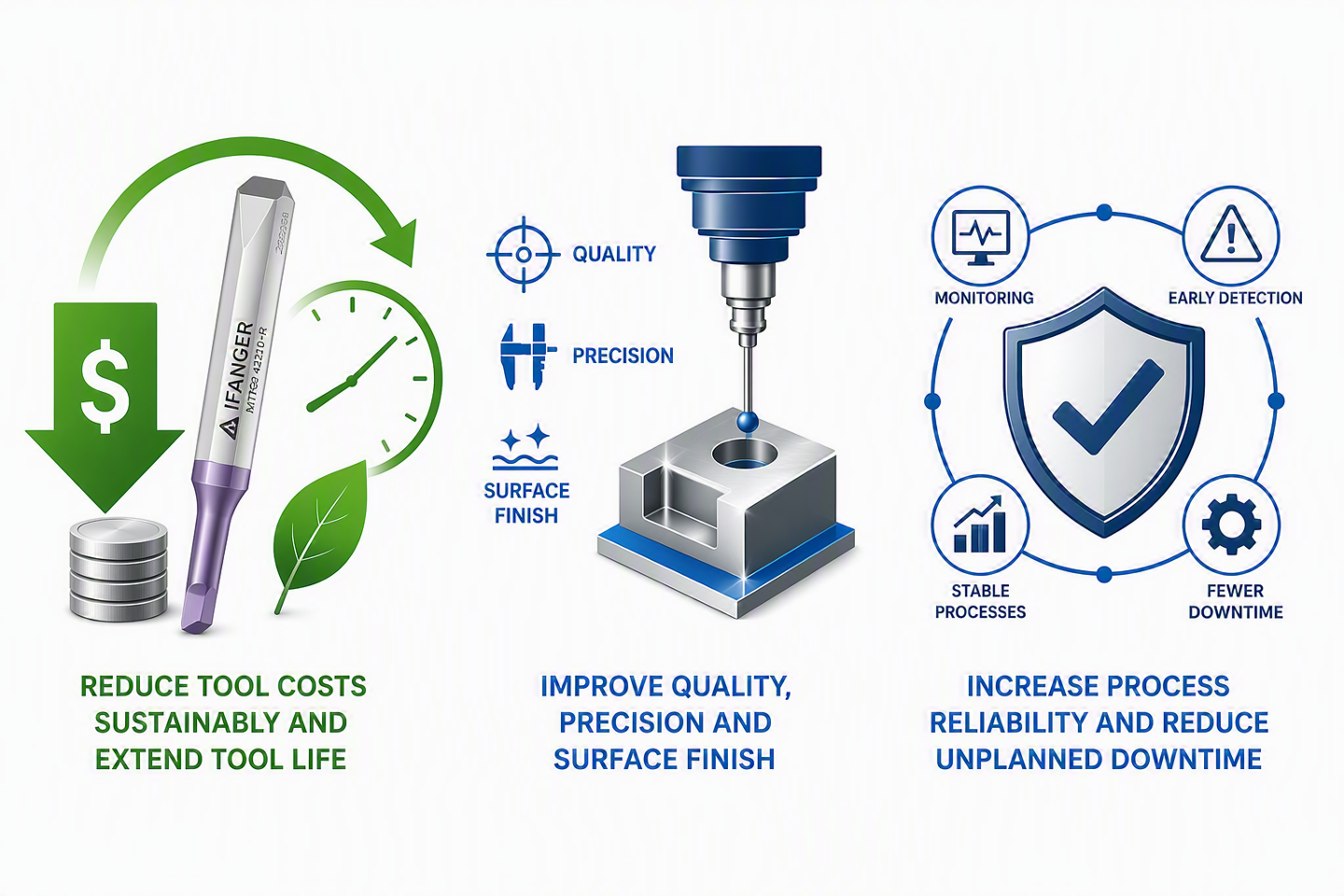
Swiss-type lathes do not tolerate compromises—especially when it comes to clamping.
Tool clamping on Swiss-type lathes is one of the most underestimated factors affecting productivity and profitability. Numerous tools must be arranged within a highly restricted workspace—often in the presence of oil and coolant—while guaranteeing collision-free machining and minimizing travel distances. Since cutting tools and tool holders are often not fully considered in CAD/CAM simulations, the burden of creating a collision-free setup falls largely on the machine operator. Combined with limited accessibility and poor visibility, precise tool alignment becomes a challenging and time-intensive task. The result is an increased risk of setup errors, collisions, machine downtime, and lost productivity—making the clamping system a critical factor in achieving efficient and reliable production.
Hidden Costs of Inadequate Tool Clamping
- Long setup times
- Collisions and tool breakage
- Machine downtime
- Frequent tool changes
- Production stress and inefficiencies
Common clamping methods for internal turning tools on Swiss-type lathes
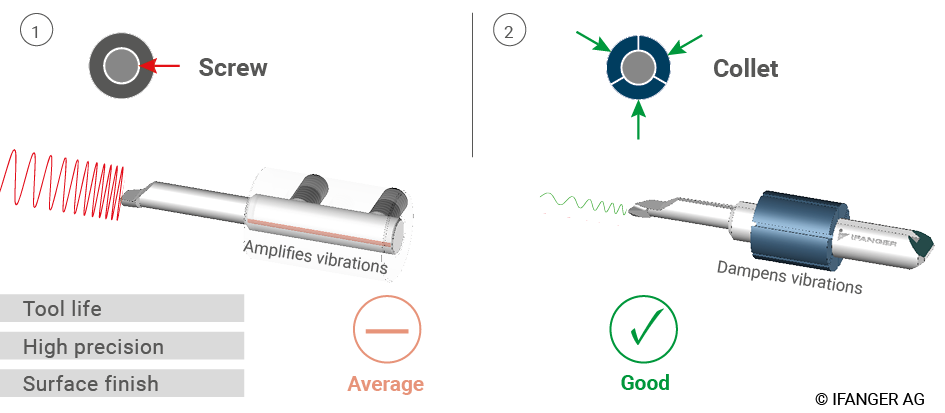
1. Tool clamping using clamping screws
In this widely used and cost-effective clamping method, the clamping forces are transmitted directly to the tool shank via clamping screws positioned on the side. Since the tool contacts the holder bore only along a linear path, the point-load application can negatively affect accuracy and the repeatability of the tool position—particularly the center height. In addition, susceptibility to vibrations increases, which can have a negative impact on surface quality, tool life, and process stability.
2. Tool clamping using a collet
With this clamping principle, the clamping forces are distributed evenly around the entire circumference of the tool shank by means of a collet. The full-contact clamping interface ensures precise tool centering, increased rigidity, and optimal force distribution. As a result, process stability is significantly improved, vibrations are minimized, and highly accurate repeatability is achieved.
Maximum precision through intelligent tool clamping
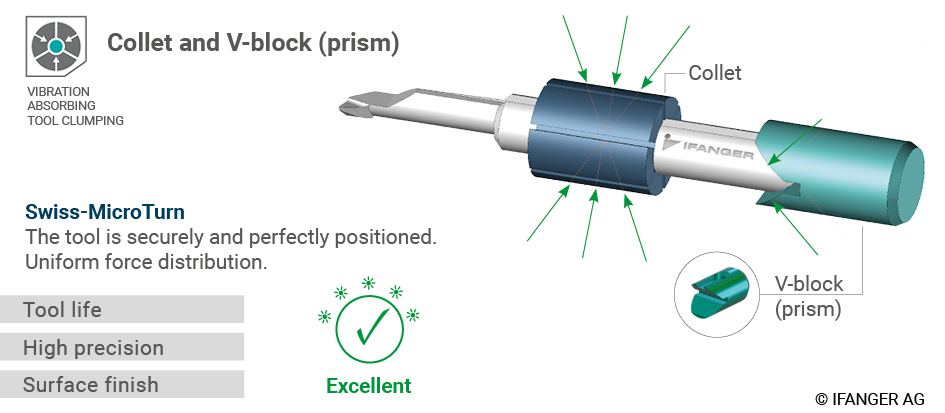
Within the IFANGER Swiss-MicroTurn system, collet chucks with integrated prisms are the preferred solution to meet the demanding quality standards of Swiss machining. The combination of full-contact 360° clamping and a V-shaped tool stop (prism) ensures highly precise tool positioning and exceptional rigidity. This robust clamping concept provides the foundation for maximum machining accuracy, superior surface finishes, and significantly extended tool life. The vibration-damping tool holder minimizes vibration and deflection, resulting in greater process stability and improved machining performance. The outcome is consistently high manufacturing quality, enhanced process reliability, and stable, repeatable results—even in the most demanding micro-machining applications. Users benefit from increased productivity, reduced setup effort, and greater confidence in unattended production.
The original with competitive advantages that keep you ahead
Although numerous suppliers now offer collet systems for micro-boring tools, the original Swiss-MicroTurn—developed by IFANGER and launched in 1997—remains the benchmark for functionality, precision, and ease of use to this day.
✔ QUICK-CHANGE
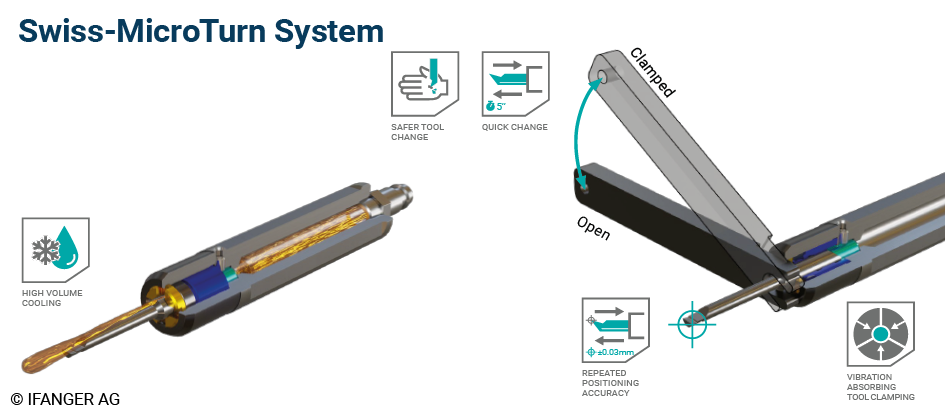
In just a few simple steps, the tool can be released, replaced, and precisely clamped again—in a matter of seconds and without time-consuming readjustment.
✔
REPEATED POSITIONING ACCURACY
Exceptionally high repeatability of the tool’s positioning. Corrections to the cutting edge position along the Z-axis are completely eliminated. This saves valuable setup time, minimizes operator errors, and increases machine availability. The result is tool changes in a matter of seconds, higher productivity, maximum process reliability, and a noticeable reduction in the machine operator’s daily workload.
✔ HIGH VOLUME COOLING
The generously sized coolant supply delivers coolant and lubricant precisely where it’s needed: directly to the cutting edge. This reduces temperatures, reliably flushes chips out of the bore, and creates optimal machining conditions.
✔
VIBRATION-ABSORBING TOOL CLAMPING
Users benefit from excellent surface finishes, high dimensional accuracy, reproducible processes, and maximum process reliability.
✔
SAFER TOOL CHANGE
A well-thought-out design ensures safe tool changes and optimal protection against cuts.
Learn more in the short video below.
Try It Out Instead of Just Studying It
See the benefits of the Swiss-MicroTurn system for yourself. Test the technology directly in your production environment and enjoy higher precision, first-class surface finishes, longer tool life, and high process reliability and cost-effectiveness.
Together, we’ll analyze your manufacturing challenges and develop concrete solutions that will help you increase your productivity and sustainably reduce your manufacturing costs.
Contact us today for a personalized consultation—we look forward to discussing this with you.